Have you ever tried to draw eyes that are supposed to look straight ahead… and somehow one ends up staring into the void while the other is judging your life choices?
Yep, same.
This practical and beginner-friendly guide on how to draw eyes will help you avoid the dreaded cross-eyed look and start creating eyes that actually feel alive. Keep reading if you want to draw eyes like a pro ✏️👀
Ready to Become a Professional Artist?
Take your art—and your life—to the next level with the Mastery Program ✨. Learn from world-renowned artists 🎨, master both classical and contemporary techniques 🖌️, and build a thriving art career doing what you love ❤️.
Apply now and start your journey to artistic mastery today 🚀
The Anatomy of an Eye
Drawing eyes gets way easier once you understand the structure behind them. Good news: it’s not as complicated as it looks.
Most eyes follow an almond shape, though some are rounder or more narrow depending on the person.
The iris (the colored part) controls where the eye is looking. If your eyes look off, this is usually the culprit.
Here’s a simple trick:
- Imagine a line from the top of the iris to the bottom
- Both eyes should follow the same angle
If those angles don’t match… you’ve created cross-eyes
Don’t forget the tear duct, that little inner corner of the eye. It should feel soft and rounded, not sharp or pointy, and should blend smoothly into both eyelids.
How to Draw Eyes Easily: Best Techniques
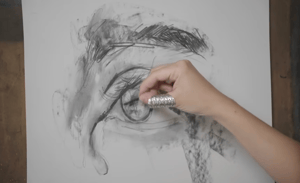
You can draw eyes with any tools you like, pencil, pen, charcoal, or digital. The process stays pretty similar across all of them.
Step 1 0 Sketch the Basic Shape
Start light. Always.
Draw:
- The almond shape
- A line for the top eyelid (slightly thicker)
- A softer line for the bottom lid
Avoid harsh outlines. Natural eyes are made of soft transitions, not bold cartoon lines.
Step 2 - Place the Iris and Pupil
Now add the iris.
A common mistake: drawing a full circle.
In reality, the iris is usually partially covered by the eyelids.
Inside the iris:
- Draw the pupil (the darkest part)
- Leave space for a highlight
Make sure both irises match in size and angle. This is where accuracy really matters.
Step 3 - Block in the Values
Think in terms of light and dark, not details yet.
Start by shading:
- The pupil (darkest dark)
- The crease above the eyelid
- The shadow under the top lid
Then build up:
- Mid-tones around the eye
- Lighter areas in the whites of the eye
Important: the “white” of the eye is not actually white.
Use light grays or subtle tones—it will look much more realistic.
Step 4 - Develop the Iris
This is where the eye comes to life.
Work from dark to light:
- Lay down a darker base color (or tone)
- Add subtle streaks radiating outward
- Gradually build lighter variations
The iris isn’t flat, it has texture, depth, and variation. Even a simple pencil drawing can suggest this with soft lines and contrast.
Step 5 - Add Highlights
This is the magic step.
Add a small, bright highlight where light hits the eye.
Tips:
- Keep it small and crisp
- Place it consistently in both eyes
- Don’t overdo it
That tiny dot is what makes the eye feel alive instead of flat.
Step 6 - Draw Eyelashes
Eyelashes are the finishing touch—the cherry on top
Key tips:
- Start from the eyelid, not the air
- Draw them in a curved, swooping motion
- Vary the length and direction
If all your lashes look identical, it’ll feel unnatural. Real lashes are messy (in a good way).
Final Thoughts
Drawing eyes doesn’t have to be intimidating. Once you understand the structure, focus on values, and take your time with the details, everything starts to click.
And remember, if your eyes look a little wonky at first, that's okay.
Stick with it, keep practicing, and soon you’ll be drawing eyes that actually look back at you.