For many artists, watercolor feels intimidating. It can feel rigid, unforgiving, and far removed from the loose, expressive way they want to paint. In a recent studio session, one artist shared a powerful breakthrough that completely shifted her relationship with watercolor. By blending abstraction, realism, and mixed media, she discovered a process that made watercolor playful, flexible, and deeply meaningful.
Her journey is a reminder that growth often comes from letting go of the rules and giving yourself permission to experiment.
When Watercolor Feels Too Tight
Like many artists, she struggled with watercolor for years. The pressure to preserve white space, control water flow, and avoid mistakes made the process feel restrictive. As someone who naturally paints fast, loose, and intuitively, watercolor seemed to fight against her instincts.
Everything changed during an artist retreat in Italy, where she learned a radically different approach that finally made watercolor feel aligned with how she wanted to create.
🌊🎨 Watercolor doesn’t have to feel intimidating. In Watercolor Foundations, you’ll learn how to work with water, pigment, and flow so you can paint with confidence, freedom, and joy ✨🖌️
The Breakthrough Technique: Abstract First, Realism Later
The foundation of this approach begins with an abstract, watery background. Instead of worrying about the final subject, the artist allows pigment, water, and gravity to do their thing. The goal is movement, softness, and surprise.
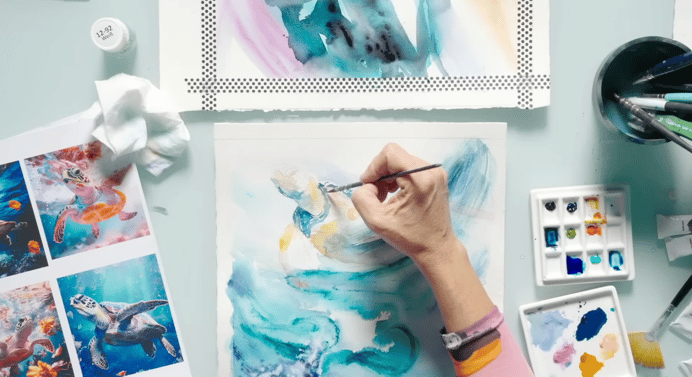
Once the background dries, a more defined subject is layered on top, often something symbolic and meaningful. In this case, turtles became a recurring motif.
Key elements of the process include:
-
Starting with colors from the same family, such as blues or greens, before introducing complementary hues
-
Letting areas of white paper remain untouched to preserve light and contrast
-
Moving from light values to midtones, then darks, and back to midtones
-
Balancing wet and dry paper for both soft edges and crisp details
-
Approaching the painting with curiosity rather than control, often saying, “Let’s see what happens.”
This method removes the fear of ruining a piece and replaces it with exploration.
 Mixing Media to Expand Possibility
One of the most freeing aspects of this process is the use of mixed media. Traditional watercolor rules say mistakes are permanent. This artist chose to ignore that.
She incorporates opaque white matte acrylic paint to reclaim highlights, fix errors, and soften areas that feel too heavy. While not traditional, it opens the door to confidence and experimentation.
Additional materials include:
-
Brusho powder pigments for bold, starburst effects
-
Unicorn Spit for shimmer and texture
-
Water-soluble gold flakes for subtle sparkle and visual interest
These materials transform watercolor into a flexible, forgiving medium that supports creative risk.
Embracing Paper Buckling and Texture
Instead of stretching paper or fighting buckling, she allows it to happen. The texture becomes part of the painting. Using high-quality 100 percent cotton paper helps minimize extreme warping, while taping the edges creates clean borders and encourages commitment to the piece.
This mindset shift turns perceived flaws into features.
Watercolor as a Teacher, Not a Limitation
Watercolor is not harder or easier than oil or acrylic. It is simply different. Many principles overlap across mediums, especially when oils are thinned and manipulated. Learning watercolor strengthens an artist’s understanding of layering, color relationships, and fluidity, skills that translate everywhere.
Most importantly, watercolor teaches trust.
Learn to Paint with Confidence and Freedom
If watercolor has ever felt intimidating or limiting, it may be time to approach it differently. With the right foundation, watercolor becomes a space for exploration, intuition, and expression.
If you are ready to build confidence, loosen your process, and truly enjoy watercolor, explore our Watercolor Foundations course. You will learn essential techniques, mindset shifts, and practical skills that support growth at every level.
👉 Start your journey with confidence HERE