Develop a personal system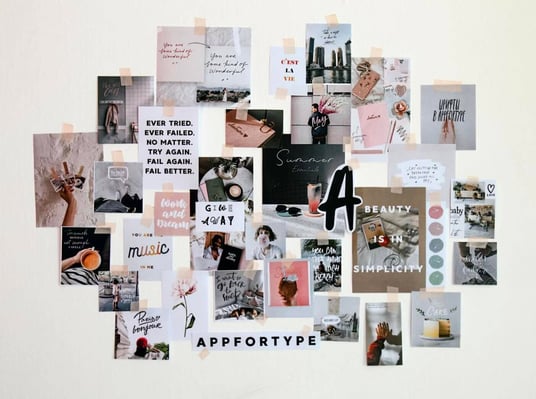
There is no single correct way to create sources. Some artists work meticulously, others intuitively. Pay attention to what helps you stay engaged. You might start with writing, then collect images. Or you might collage first and reflect later. Allow your system to evolve alongside your painting practice.
Think of source creation as a parallel studio practice. It can be quiet or chaotic, structured or open-ended. What matters is that it feels personal and alive.
Begin with reference gathering
References are not about copying. They are about seeing. Start by collecting images that resonate with you for any reason at all. This might include photographs you take yourself, screenshots from films, museum images, drawings from life, or fragments from books and magazines. Let curiosity guide you rather than accuracy.
Try gathering widely at first. Architecture, gestures, textures, light conditions, color relationships, and even unrelated subjects can all become useful later. Over time, patterns will emerge that reveal what you are truly drawn to.
Build inspiration boards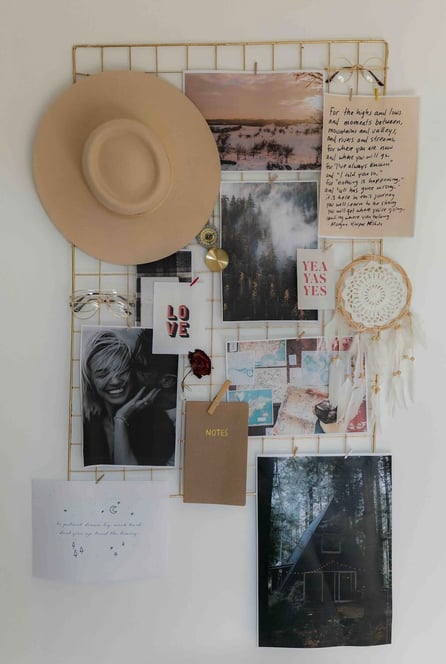
Inspiration boards help you think visually before you paint. They allow you to see relationships between images and ideas without forcing conclusions too early. Digital boards can be especially useful because they are easy to revise and expand.
Pinterest remains a powerful tool for this stage. Use it as a visual sketchbook rather than a final answer. Create boards around moods, palettes, subjects, or questions you are exploring. Save freely, then revisit and refine. Other options include Milanote, PureRef, or simple folders on your desktop.
Physical boards can also be valuable. Printing images, pinning sketches, or arranging postcards can slow the process down and make it more tactile.
Use AI as a thinking partner
AI tools can expand your source material when used thoughtfully. ChatGPT can help you brainstorm visual directions, generate conceptual prompts, or suggest unexpected combinations of themes. You might ask it to describe a scene, propose symbolic elements, or help you articulate what you are trying to express.
Image based AI tools can also be used to explore variations, lighting scenarios, or compositional ideas. Treat these outputs as starting points, not solutions. Edit them, distort them, redraw them, and combine them with your own references. The goal is not perfection but stimulation.
Experiment with digital tools
Just as you test brushes and surfaces in painting, experiment with tools for building sources. Pixelmator is excellent for quick image manipulation and color exploration. Sketch works well for drawing and layering ideas in a loose way. Adobe Photoshop and Illustrator offer more control for complex collages and studies. Canva can be surprisingly effective for fast layout experiments and mood boards.
You might also explore Procreate for sketching, Blender for basic spatial studies, or photography apps that let you manipulate light and contrast. The specific tool matters less than your willingness to play.
Let the process remain fluid
Your sources are not fixed. As your painting develops, your references can change too. Add new material, discard what no longer serves you, and allow discoveries made in paint to send you back to your boards and sketches.
We believe strong paintings grow from active looking, thoughtful gathering, and fearless experimentation. When you give your sources the same care and curiosity as your painting process, they become a foundation for work that is both informed and deeply your own.